Whats going on?
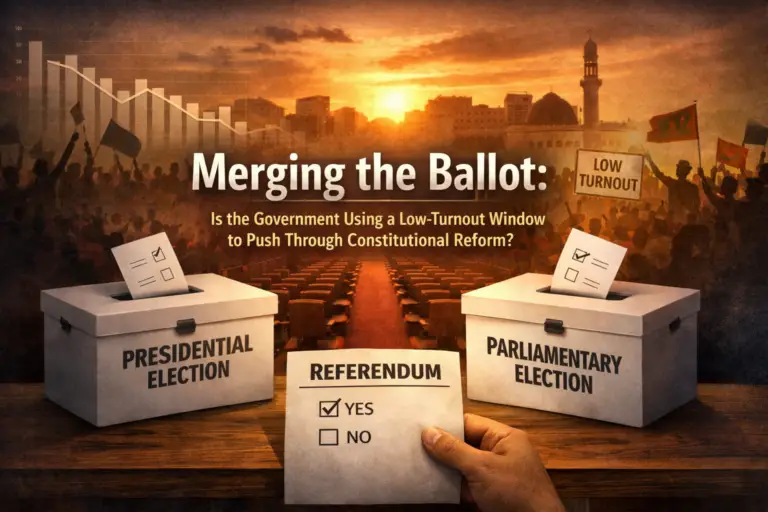
President Muizzu first announced his intention to amend the constitution to combine the Presidential Election and Parliamentary Election during a speech in function to inaugurate the ruling party, PNC’s new Party Centre in 7th July 2024. In February 2025, during the Presidential address at the opening of the Parliament’s 2nd Sitting of the term, President Muizzu announced reaffirmed his intention to submit a bill that will combine both the presidential election and the parliamentary election. In the Maldives, Presidential elections are usually held on September of the fifth year of the term with the President being sworn in on November 11. Parliamentary Elections are held 6 months after in March. Combining the two would mean the current Parliament’s term will be cut short by 6 months. Such a change to the constitution would require a referendum too.
The bill has been submitted to the parliament. While the Parliament is in recess, has held a special sitting to debate the bill on 5th January 2025. Opposition raised concerns that the Government was trying to push through the bill while majority of opposition MPs were away during the recess. Furthermore the main opposition MDP decided to boycott related sittings citing a lack of chance to make their voices heard on the bill.
So the President hopes to pass the bill from the Parliament, where the ruling Party hold a super majority, and hold the referendum along with the upcoming local council election on 4th April 2026. An election the current President would be all too familiar with as he was the Mayor of the Capital City right before becoming the President. An election with the lowest turn out in the Country.
Insight into the local Council Election
Since its inception into the constitution, the Maldives have had four local council elections (2011, 2014, 2017 and 2021). Island councils, City councils, Atoll councils and a women’s development Council (for each Island and City) is elected during the election. 2011 was the first council election. Before then “Rashu Katheebu” (Island administer) was appointed by the President for each Island. Similarly, “Atolhu Veriyaa” (Atoll Administrator) was appointed to each Atoll. These were mostly, then President Maumoon Abdul Gayyoom’s loyalists. In the first ever LCE in 2011, Dhivehi Rahyithunge Party (DRP), took a majority of Island (45%) and Atoll (53%) councils. However the newly formed Maldivian Democratic Party (MDP) took a majority in the City Councils (88%). Since then in every LCE (2014, 2017, 2021) MDP has taken the majority of Island (48%, 45%, 43% respectively), City (82%, 91%, 53% respectively) and Atoll (44%, 61%, 61% respectively) Councils. MDP has always leaned left with a decentralization focus. DRP and its offshoots, PA, PPM, PNC has always leaned right with a more centralization focus. In all elections, Independent candidates have won on average only 16% of the seats in total.
Voter turnout is low in Cities, especially in the Capital City of Malé where most of the population is concentrated at. On average voter turn out has been at around 54% when considered for all Cities (Malé, Addu, Fuvahmuluah and later Kulhudhuhfushi). Even lower at 45% when considered for Malé alone. In the Capital the disinterest might stem from the fact that the City Council has little power in actually implementing changes with the Central Government still maintaining control over much of the City, especially Hulhumale, a district of the Capital City run by a State owned Enterprise (HDC). Male’ City Council is left with most municipal responsibilities. In the Islands the picture is a bit different. Big families vie for the post of Island Council President and competition fires up with turnout at around 80% on average.
According to the 2022 census, around 41% of the Maldivian population lives in the Capital. It is safe to say by now the figure will be close to around 45%. From this there the turnout for the last Presidential Election in Male’ was more than 77% and turnout for the Parliamentary Election was around 64%.
What Happens when the Bill Passes?
The bill was presented to the Parlimant on behalf of the Government by PNC’s PG leader MP Ibrahim Falah. The amendment, submitted by the ruling PNC, was passed with 46 votes in favor and referred to the Independent Institutions Committee, which has set a deadline for completing its review and opening the bill for public comment. After public comments, the bill will be presented to Parliament for a vote. The most likely scenario is that the bill will be passed by the parliament which has as supermajority of ruling Party. Once the bill is passed the upcoming local council election will also have a referendum asking the people whether they are in favor of combining both elections.
If the people vote in favor that means the next parliament (21st Parliamentary assembly) will be inaugurated in 1st December 2028, after the combined Presidential and Parliamentary Election in September 2028. This would also mean the ongoing 20th Parliamentary assembly will conclude before it completes the normal 5-year term in order to accommodate the change.
What do the leaders say?
Former MDP Chairperson, Mr. Fayyaz Ismail raised concerned regarding the intention of the Government saying it does not align with the Government’s actions of overexpending. Furthermore, he proposed an alternative approach of combining the Presidential Election with half of the Parlimentary seats while the other half can be elected mid-term, giving the people time to better analyze the effectiveness of the Government before electing representatives to make the Government accountable. Current MDP President, Mr. Abdulla Shahid viewed the merger as a fraudulent and malicious attempt to disrupt the Elections.
Former President Nasheed has backed the Government’s proposed saying that it is a good idea. Former President Yameen warned that merging the two elections deprives people of a parliament that makes the Government Accountable. However, it should be noted that since President Yameen’s administration, the ruling Party has held increasing majority of seats in the Parliament making oversight nearly nonexistent.
Some Pros
Even if Maldives is a Presidential System, it borders on parliamentary style whereby it is nearly impossible to hold power and complete the term for a president if the ruling party does not hold majority of the Parliament. Since the Parliamentary elections are always just around the corner by the time the new President is sworn in, after all the appointments including Ministrial posts, SOE heads and other important positions, the President’s focus turns to the upcoming election election rather than the people. Merging the two would mean whoever is elected can start focusing on the Country and its People sooner.
The main benefit narrated by those for the change is the cut in costs. Governments estimates that around MVR 120 million would save in expenses if the two biggest elections the Country sees are combined into one. President Muizzu cited in a speech that over MVR 180 million was incurred for the two rounds of the last Presidential election and over MVR 120 million was incurred for the last Parliamentary Election.
Some Cons
While opposition also agrees that it will cut costs, they raise concerns around the fact that Government can cut the same, if not more in costs, if the Government would stop its exaggerate spending elsewhere.
Combining the referendum with an election with the lowest turnout might mean only a few people, especially party hardliners might decide a big constitutional change. Furthermore the current Government has downplayed the importance of councils and blamed them for the lack of progress in the Islands. Government has also abolished the Atoll councils in the name of cutting costs while increasing the political staff at the newly Created Atolls ministry. Coincidentally this increase in staff goes well with the coming local council election.
Such a referendum might instill more to come out and vote in the local council elections too, having a positive impact for both the referendum and the election. However, the historical lack of interest in the local council election and the narrative pushed by the Government, might mean the turnout remains on par with past elections. This raises concerns if the Government is using the low turn out window to push through the constitutional reform.
Referendums in the Maldives
In recent memory, Maldivians saw a referendum asking to choose whether they prefer a Presidential system or a Parliamentary system. Many including President Nasheed, cite that that referendum was held without properly educating the people on the pros, cons and differences of the system and have advocated for a second referendum now that people are more aware of the two systems.
Last year a bill was passes by the Parliament that establishes a framework within which the Government can hold referendums and ask people’s opinion before major changes. The first referendum after the bill was introduced was the Addu referendum. President Muizzu has expressed his intention of annulling the second round of the Presidential election which would also require a referendum.