Executive Summary
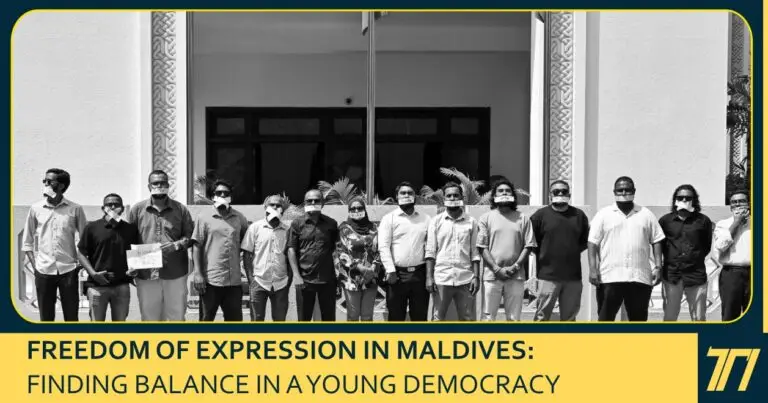
Recent events surrounding the imprisonment of journalists and the issuance of a court gag order have reignited national debate on freedom of expression in the Maldives. A historic meeting between former presidents Abdulla Yameen, Mohamed Nasheed, and Ibrahim Mohamed Solih highlighted growing concern that fundamental democratic rights, particularly media freedom, may be under threat.
Since the democratic transition and the 2008 Constitution, Maldivians have enjoyed legally protected freedoms of expression, media independence, and peaceful assembly. However, successive administrations have struggled to balance these freedoms with concerns over public order, religious sensitivity, national security, and protection of reputation. Each government, regardless of political alignment, has faced criticism for introducing laws or practices perceived as restricting dissent once in power.
The Maldives identity as both a constitutional democracy and a deeply Islamic society adds complexity to this debate. Islamic principles emphasizing truthfulness, verification of information, and accountability of leadership can reinforce responsible freedom of expression rather than undermine it. The current controversy raises a central question: where should legitimate regulation end and suppression begin?
The article argues that the problem is not the existence of restrictions themselves, which are sometimes necessary, but the selective or excessive use of legal tools to silence criticism. Sustainable democratic governance requires clear legal standards, proportional restrictions, judicial independence, protection of journalistic sources, and stronger media ethics frameworks.
Ultimately, freedom of expression in the Maldives has moved beyond the struggle to obtain rights. The country now faces the more difficult challenge of preserving those rights responsibly, ensuring that governments, media institutions, and citizens collectively uphold democratic principles while maintaining social cohesion.
Background
Friday the 15th will go down as a historic night in the Maldives. Three former (and aspiring) presidents set aside their differences and held a joint meeting. The main catalyst for the meeting between Abdulla Yameen, Mohamed Nasheed, and Ibrahim Mohamed Solih was growing concern over infringements on media freedom and freedom of expression.
The meeting followed the controversial imprisonment of two journalists and a gag order issued by the Criminal Court of Maldives restricting public discussion of an ongoing matter.
Freedom of expression has once again become one of the most debated issues in the country. Questions surrounding media freedom, public criticism, religious sensitivity, and state authority reveal a deeper challenge faced by all young democracies: how to protect freedom while maintaining social cohesion.
There was a time when Maldivians had to think twice before expressing opinions against those in power. Many grew up hearing stories of harsh punishment for dissent. Freedom of expression and the right to protest were once unfamiliar concepts for the majority.
Then a brave few challenged the status quo and brought democratic reform to the turquoise shores of the Maldives. Elections were institutionalized, political parties were registered, and citizens gained the right to protest and express opinions openly. Independent media outlets and bloggers emerged, while the 2008 constitutional reforms enshrined these freedoms in law.
Article 27 – Freedom of Expression
Everyone has the right to freedom of thought and to communicate opinions and expression in a manner not contrary to any tenet of Islam.
Article 28 – Freedom of the Media
Everyone has the right to freedom of the press and other means of communication, including the right to espouse, disseminate, and publish news, information, views, and ideas. No person shall be compelled to disclose the source of information they publish.
Article 33 – Right to Protect Reputation and Name
Everyone has the right to protect their reputation and good name.
Despite these guarantees, one persistent question has remained: where do we draw the line? What constitutes legitimate regulation, and what becomes infringement upon fundamental rights?
Successive administrations have attempted to define this boundary. While some reforms were welcomed, many were viewed as mechanisms to control public discourse.
During President Nasheed’s administration (2008–2012), the government passed the Freedom of Peaceful Assembly Act in 2010, requiring 72-hour advance police notification for public gatherings. Police were accused of using excessive force against protesters, and some demonstrators were jailed. The situation became particularly tense during the 2011–2012 protests that led to President Nasheed’s resignation. Journalists were often caught in the crossfire of political violence, facing attacks from both government supporters and opposition groups.
Under President Yameen’s administration (2013–2018), anti-defamation legislation was widely used against media organizations and social media activists. The opposition-aligned broadcaster RaajjeTV received heavy fines, while counterterrorism laws were applied against opposition politicians, activists, and journalists. A 2016 amendment to the Freedom of Peaceful Assembly Act restricted rallies in Malé to designated areas such as the carnival grounds.
During President Solih’s administration (2018–2023), the Evidence Act allowed courts to compel journalists to reveal confidential sources, a move critics argued contradicted constitutional protections under Article 28. Report also show increasing cases of police harassment and excessive force against journalists, particularly those covering opposition rallies.
Across three administrations, the country also witnessed violence against journalists, including stabbings, abductions, and even murder. Justice has remained elusive in many cases.
At the press conference held on Friday night (15 May 2026), the three former presidents acknowledged that their administrations were not perfect and that mistakes had been made. They stated that their purpose in meeting was to ensure that current and future governments do not undermine fundamental freedoms.
Religious and Cultural Perspective
The Maldives is both a constitutional democracy and a deeply Islamic society. These identities do not inherently conflict. Islamic principles emphasizing truthfulness, verification of information, and accountability of rulers can strengthen responsible freedom of expression rather than restrict it.
Maldivians have historically been known for hospitality, community solidarity, and respect for leadership. Some argue that these qualities have weakened in the era of democratic contestation.
As a predominantly Muslim nation, Islam plays a central role in public life. Islamic teachings instruct believers to verify information before spreading it, a principle highly relevant to modern journalism and today’s social-media-driven information environment. Islamic tradition also praises speaking truth to unjust authority as a noble moral struggle.
From this perspective, journalists asking questions of leaders is not an act of hostility but an essential process of verification. Yet today, journalists have been jailed simply for asking questions. This raises the central dilemma once again: where should the line be drawn?
The Problem
While in opposition, nearly every political movement in the Maldives has championed freedom of expression, freedom of assembly, and media independence. However, once in power, governing priorities often shifts.
Throughout the country’s short democratic history, both major political camps have faced accusations of restricting freedoms while governing. Each administration reopens the same debate: how much freedom is too much freedom?
Today, journalists have been jailed for raising questions related to allegations involving the President, while the Criminal Court has imposed a gag order preventing public discussion. Former presidents have openly challenged the order without facing legal consequences, creating a perception of selective enforcement against journalists.
The Solution
Different societies strike different balances between freedom and stability. Some prioritize social harmony over unrestricted speech, while others maximize individual liberty even at the cost of polarization.
The Maldives occupies a unique middle ground, attempting to reconcile democratic openness with cultural and religious continuity.
Before drawing limits, it must be acknowledged that certain restrictions on expression are legitimate, including those related to national security, incitement to violence or hatred, and protection of reputation and individual rights.
The problem arises when these justifications become tools to suppress criticism favorable to those in power.
Achieving balance requires clear legal standards:
- Restrictions must be proportional to actual harm.
- Laws must pass a necessity test, asking whether less restrictive measures could achieve the same objective.
- Legislation must be precise and avoid vague wording that enables abuse.
Journalists must retain the ability to protect confidential sources. The judiciary must remain independent from executive influence to ensure meaningful oversight. A strong media ethics framework should be developed alongside public education on rights and responsibilities.
Equally important is consistent behavior from political leaders. Respect for freedom cannot depend on who holds office.
Freedom of expression in the Maldives is no longer about gaining rights. It is about learning how to sustain them responsibly. The success of the Maldivian democratic experiment will depend not only on laws, but on collective maturity from governments, media institutions, and citizens alike.